
Warning: This is not a science post.
On December 11, 2018, the U.S. Environmental Protection Agency (EPA) and the U.S. Army Corps of Engineers made available their proposed rewrite of the 2015 “Clean Water Act Rule.” This revised rule will be posted in the Federal Register, however the EPA has already made it available on their website for advance review. The new revised Rule is entitled simply “Waters of the United States (WOTUS) Definition”, which is what this Rule was about from the beginning. I always thought that the previous title of “Clean Water Act Rule” was simply a ruse to confuse people about the intention of its contents.
The Clean Water Act (CWA) applies to “navigable waters of the United States.” The definition of what is a “navigable water of the United States” prior to 2015 was so obtuse that enforcement often ended up in litigation. Several of these cases have made their way to the Supreme Court for resolution.
EPA’s rewrite of the Rule in 2015 was supposed to clear up the inconsistencies in the application of the regulations. EPA’s idea at the time was to use science to define a “WOTUS.” The Agency conducted a science review of the physical, chemical and biologic connections between water bodies and used the resulting report in providing a definition. The problem is that the natural world is a messy sort of place where pretty much everything connects with everything else. The natural world does not fall into a neatly laid out legal scheme such as the Clean Water Act. So the 2015 Rule encompassed almost every drop of water in the United States into the definition of a “WOTUS.”
Back in 2015, I posted quite a bit on the “Clean Water Rule” (check out this link to read past posts https://waterblogger.org/water-quantity/a-review-of-the-environmental-protection-agencys-connectivity-of-streams-and-wetlands-to-downstream-waters-post-1/) and I have been following the subsequent litigation over that Rule. I would put the 2015 rule making process in the category of one of the most disastrous examples of federal regulatory efforts ever. It has resulted in a patchwork of 22 states across the country where the 2015 “Clean Water Rule” is in effect, while the rest of the states are still using pre-2015 regulations and guidance of what constitutes a WOTUS. This is because the chief plaintiffs in the lawsuits against EPA were the other 28 states. These states consider waters within their boundaries as mostly state waters to be managed by them. A federal court set aside implementation of the regulations in the states that sued until litigation was complete. Below is a map taken from EPA’s website that shows where the two different regulations are in effect.
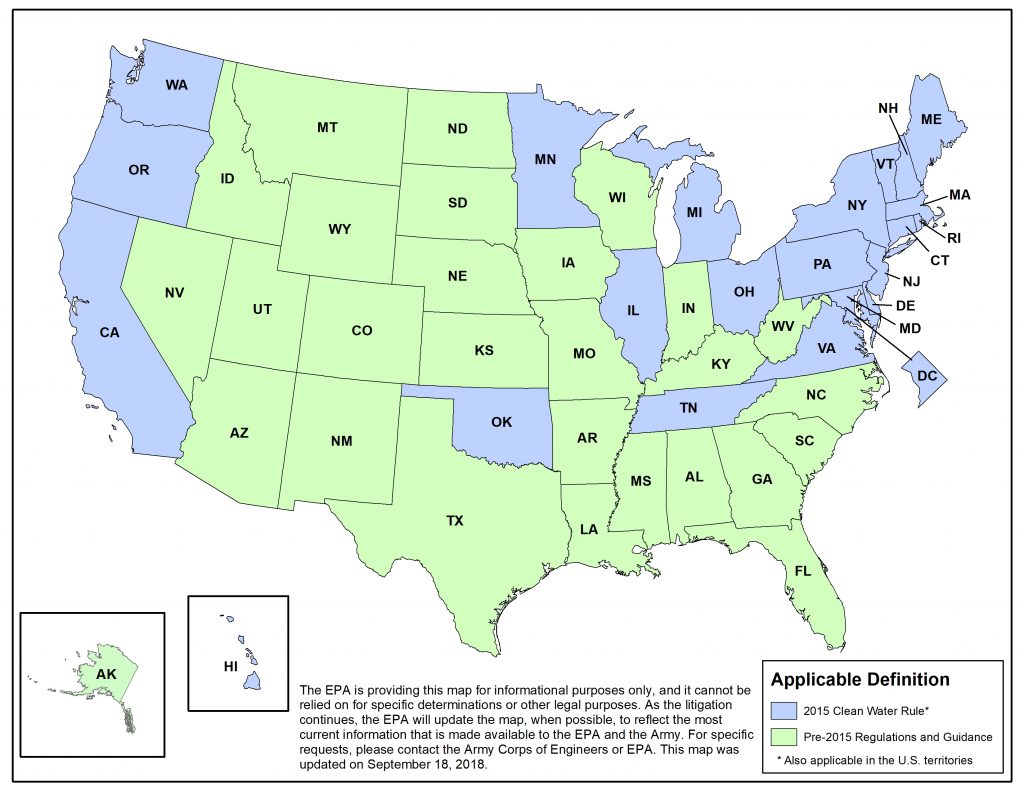
The revised 2018 Rule tries to simplify the definition of a “WOTUS” by making it a legal definition instead of a definition based on science. Hence my warning above saying there is no science in this post. The preamble to the 2018 Rule says it best and I quote: “The line between Federal and State waters is a legal distinction, not a scientific one, that reflects the overall framework and construct of the Clean Water Act.”
In brief EPA has defined “WOTUS” to be: “traditional navigable waters, including the territorial seas; tributaries that contribute perennial or intermittent flow to such waters; certain ditches; certain lakes and ponds; impoundments of otherwise jurisdictional waters; and wetlands adjacent to other jurisdictional waters.”
The new revised Rule does not include ephemeral tributaries which flow only as a result of precipitation. This is a major change from the 2015 Rule. The 2015 Rule considers all tributaries, including ephemeral ones, as WOTUS if they contribute flow directly or through another water body to a WOTUS and have the physical indicators of a bed and banks and an ordinary high water mark. I consider this the make work for hydrologists provision of the 2015 Rule. Each decision would have to be made by a hydrologist. In the case of ephemeral streams, it could result in an argument between any two reasonable hydrologists as to the above mentioned physical indicators. It could all end up back in court again.
In fact much of the 2015 Rule relies on case specific analysis of a particular water to determine if there is a clear connection to another water which is a “WOTUS.” The writers of the 2018 Rule have taken the stance that anyone should be able to identify what a “WOTUS” is from the regulation. The 2015 Rule was 9 pages. The 2018 Rule is 60 pages. I suppose this is in hopes that a farmer or developer can take all those extra pages with them and stand next to their ditch or wetland and see if it fits within the definition. I joke of course. Most of the extra pages are just references to sections of various laws which need to be amended with the new definitions. The Rule does little to help your average non-scientist or non-lawyer to clearly differentiate between what is covered and what isn’t.
There are some definitions which could help the average Joe in determining if they have a WOTUS. For example, ditches constructed in uplands are not regulated under the 2018 scheme. This is a major victory for the farmers as they are the ones who probably have the most ditches on their property and who were some of the people most upset by the 2015 “Clean Water Rule”. Upland is defined as any land area above the high water mark or high tide line that doesn’t satisfy wetland criteria of having wetland hydrology, hydrophytic vegetation (plants that live in submerged conditions), and hydric soil (saturated soil) under normal conditions. Unless it’s a ditch like the Erie Canal that you can navigate, a ditch altering a tributary or built in an adjacent wetland to a WOTUS then you can be pretty confident that you are not going to have to get a federal permit under this new Rule.
There’s also a fairly sharp line drawn for what lakes and ponds qualify as a WOTUS. A lake and pond has to have a clear surface water connection to a WOTUS or be flooded by a WOTUS during a typical year for them to be considered as regulated under the CWA. Isolated ponds even though they might have some hydrologic connection via groundwater to a WOTUS are excluded.
What is surprising and to me not clear at all is the application of the 2018 Rule to wetlands. The only wetlands to be considered WOTUS are those that are adjacent to waters regulated under the new 2018 Rule. Adjacent means the wetland must abut a WOTUS. Abut in the regulations is defined as where a wetland actually touches a WOTUS at either a point or a side. The wetland also must have a direct surface connection to the WOTUS. No subsurface groundwater connections allowed. Any wetland that is physically separated from a WOTUS by upland, or by dikes, barriers or similar structures is not regulated. The preamble says that this will end the need to make case specific evaluations of wetlands to determine if they have a hydrologic connection to a WOTUS.
I doubt it. This is going to be far more difficult than the writers of this Rule imagine. Property owners will neither be able to make the determination themselves that there is a direct surface connection which occurs either from a wetland being inundated by a regulated water such as a tributary, lake, pond/impoundment, or ditch, nor in many cases are they going to be able figure out if there is surface flow from the wetland to the regulated water. No that is going to take a professional determination.
There are a number of other exclusions to the application of the Rule specified in the text including groundwater, prior converted cropland, artificially irrigated areas for rice and the like, stock ponds, settling basins, log cleaning ponds, water filled depressions as part of a mining or construction, gravel and fill pits, storm water ponds and waste water treatment systems. I suspect once the Federal Notice comes out there will be quite a few comments made to the public record and we will see another rewrite, but it is unlikely in my opinion that we will see anything that can satisfy the EPA Administrator’s desire for a set of regulations whereby the average person will be able to make a determination of whether a water body is a WOTUS. Trying to regulate natural hydrologic systems is about as clear as the mud in a wetland.