
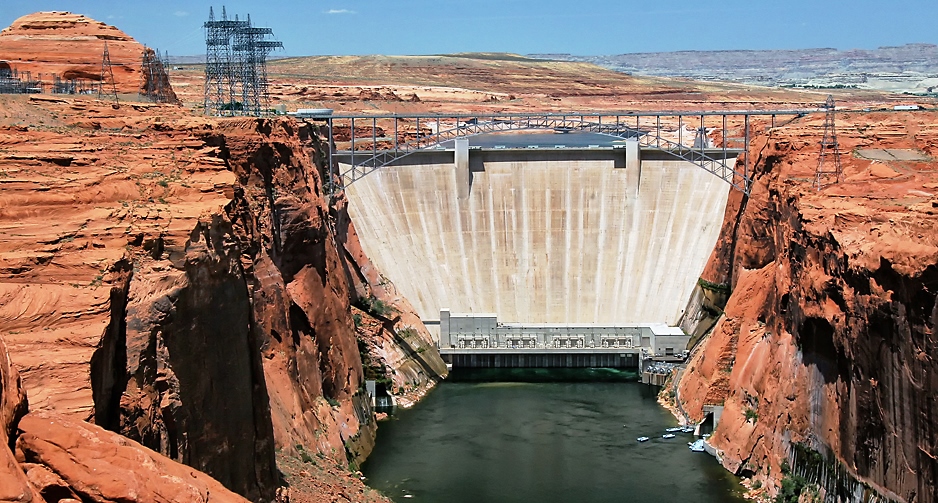
The U.S. Bureau of Reclamation just issued a Record of Decision on hydrologic management of the Colorado River. It establishes a framework for operation of Lake Powell and Lake Mead. The framework is outlined in the Bureau’s Post-2026 Operational Guidelines and Strategies for Lake Powell and Lake Mead https://www.usbr.gov/ColoradoRiverBasin/post2026/final-eis/index.html. This document will replace the expiring Colorado River management agreements at the end of 2026.
Reclamation was hoping that the seven states which the Colorado River runs through and who are the primary users of the water from the river would come together and produce their own consensus-based agreement but of course that never happened, so the Bureau stepped in to make sure there was something to replace the existing agreements. The Bureau of Reclamation operates the dams on Lake Powell and Lake Mead so that is their main focus. There has to be enough water in the lakes to operate the dams. Period.
The west has been in drought conditions for years now and water levels in the lakes and in the whole reservoir system that the Bureau operates are dangerously low. Yet the lower basin states (California, Arizona, and Nevada) go blissfully on like nothing is happening. Out of control growth and overpopulation. It’s no wonder that the upper basin states of Wyoming, Utah, Colorado and New Mexico can’t make an agreement with these water hogs. Wallace Stegner the great American author wrote a book called Beyond the Hundredth Meridian that tells the tale of the whole development of western water management policy in the United States. It’s the story of John Wesley Powell whose first navigation of the whole of the Colorado River is legendary. Few people know though that Powell was the one who pushed for the western water management system that we have now. He told the idiots in Washington that there wasn’t enough water beyond the 100th meridian to support future western expansion and the idiots basically said, “so fix it.”
Now after years of drought and changes in climate conditions the truth of it all is apparent. It cannot be fixed. Even the new “operational guidelines and strategies” is admitting this because it relies on adaptive management practices. If you haven’t heard this term before, it means “an iterative method of decision making in the face of uncertainty.” Previously known quantities of water were scheduled for release on a yearly basis so water managers in states could plan. No longer. Now The ROD establishes operating guidelines through 2036 that will be determined in 2-year increments. What you get in 2027 may not be what you’re going to get in 2029, unless a broader consensus among the Colorado Basin States supports a longer duration (I’m personally not waiting for that to happen).
From what I can tell, 2027 will start with a range of possible releases of water from Lake Powell to the downstream Lower Basin States of 5.0 million acre-feet (maf) to 12.0 maf. This entails shortages for the Lower Basin of up to 3.0 maf. The Bureau plans water storage in Lake Powell of up to 8.0 maf and 3.0 maf in Lake Mead. The Bureau also is planning for voluntary Upper Basin conservation of up to 200,000 acre-feet (good luck with that).
I wrote a blog post many years ago about the poor old Colorado River and the stress that it was undergoing. You can read that post by clicking here An American River in Distress . I have been writing a lot about Water Bankruptcy recently. The definition of water bankruptcy is “the critical condition in which water resources are depleted or so severely mismanaged that they can no longer meet the essential needs of populations, ecosystems, and economies”. To read my post on Water Bankruptcy click on this link Is the World Really in Global Water Bankruptcy? . Is the Colorado River in Water Bankruptcy? This is a very good question. I’m going to attempt to answer that question in the next few months by looking at the recent hydrologic studies of the river. So as they say in the biz: “Stay tuned.”