
The recently issued United Nations University Report Global Water Bankruptcy says: “The world is already in the state of “water bankruptcy”. In many basins and aquifers, long-term overuse and degradation mean that past hydrological and ecological baselines cannot realistically be restored. While not every basin or country is water-bankrupt, enough critical systems around the world have crossed these thresholds.”
Strong words and new words. What do they mean by “water bankruptcy?’ The term is defined in the report as the critical condition in which water resources are depleted or so severely mismanaged that they can no longer meet the essential needs of populations, ecosystems, and economies. The conclusion that we are now bankrupt is based on statistics. Very interesting. Not scientific proof, just statistics.
For example, the report says that nearly three-quarters of the world’s population live in countries classified as water-insecure or critically water insecure. Insecure is the mumbo jumbo word now used to mean insufficient. So, there is basically insufficient water for the population of these countries. The report also cites that about 4 billion experience severe water scarcity for at least one month a year.
Groundwater is reported to now be the source of 50% of global domestic water use and over 40% of irrigation water and that around 70% of the world’s major aquifers are showing long-term declining trends. Excessive groundwater extraction has in turn led to significant land subsidence because when you extract water and lower the water table, aquifer materials such as sand and silt compact. Compaction basically destroys the ability of the affected acquirer to recharge itself with water. The report says that over 6 million square kilometers—almost 5% of the global land area— is subsiding due to groundwater extraction.
Our biggest source of water though is surface water – rivers, streams, and lakes. They cite that a growing number of major rivers now fail to reach the sea (like the Colorado River – see my blog post here An American River in Distress ) or fall below environmental flow needs for significant parts of the year. No statistics are provided here; it’s just based on anecdotal observation. The report goes on to say that more than half of the world’s large lakes have lost water since the early 1990s, affecting around one-quarter of the global population that depends directly on them for water security.
Very interestingly the report states that about 70% of the world’s global freshwater withdrawals are used for agriculture and that more than 170 million hectares of irrigated cropland are under high or very high-water stress meaning again that there is insufficient water for irrigation at times.
So, what does the report say is the cause of global water bankruptcy? People. Of course, they couch it in terms of the “Anthropocene” the word now used to mean the period of time since humans have started affecting their natural environment with their activities.
The chart I like best in the report is this:
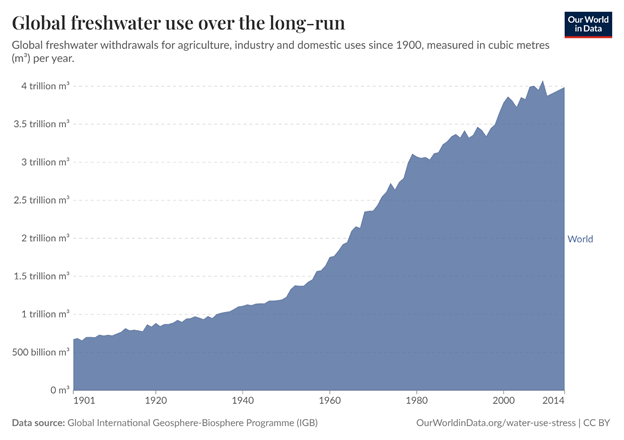
The chart shows the increase in freshwater use from the early 1900’s to today. Use rose precipitously starting in the 1960’s. They should have put the chart below right next to it because it shows an identical increase in population:
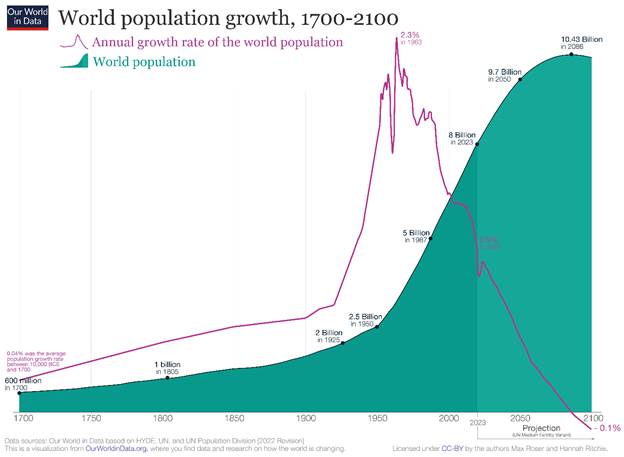
Trends indicate that by 2030, demand for water is expected to outstrip supply by 40 percent, driven by population growth, urbanization, and increased agricultural and industrial use. Apparently water bankruptcy will be the norm. However, the report provides no scientific measures for determining when a water system is in bankruptcy. Case studies are cited but there is no definitive presentation of a way to classify a system as bankrupt. In my view this is the big failing of this report. It only coins a new term and attempts to define it but lacks rigor in its presentation. So, the question still remains: are we in the midst of global water bankruptcy?
I will attempt in my blog to look into large water supply systems and determine if they are indeed in a state of bankruptcy. I will start with one of the most prolific aquifers in the United States – the Floridian.