
Is The Floridian Aquifer in Florida in Water Bankruptcy?
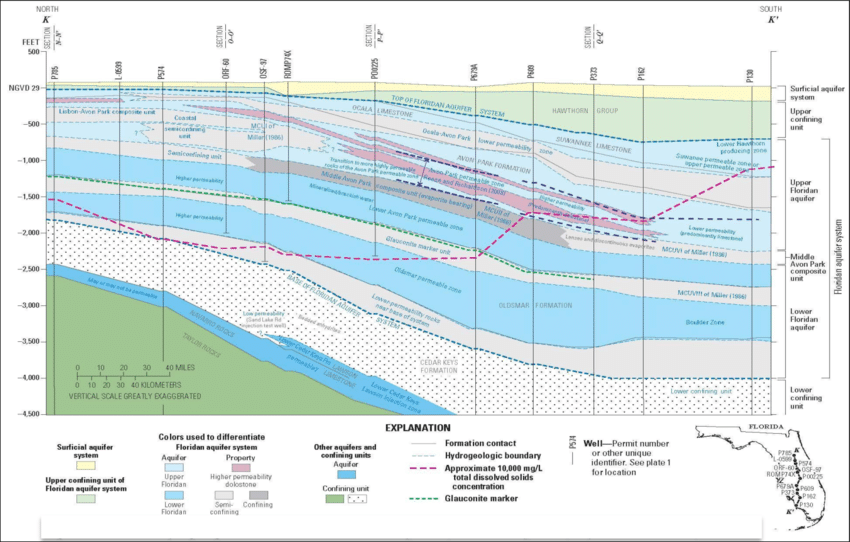
United States Geological Survey: Crosseection of the geology of the Floridian aquifer
Florida is a big state of some 66,000 square miles and it has a lot of people, nearly 25 million. About half of them depend on the Floridian aquifer as a water source. The interesting thing is most of the people who live in Florida are not from Florida. They are from big cities up north that primarily get their water from rivers. The majority of people in Florida if asked would probably not be able to say where their water comes from and after all why should they worry, as good grief, it seems to be plentiful. It’s not like California where there are all sorts of water restrictions and you have to landscape your yard with ugly white stones instead of grass. No when a Floridian turns on the tap they let it run.
The water may be plentiful but it is deemed hard by water treatment specialists. That’s because of the geology of the Floridian aquifer. To understand an aquifer you must understand the geology. Looking at Florida on a map you see that it looks like a tail wagging the dog of the North American continent. If you look at it from the air, it looks very, very flat. This is a result of how it was formed. Some 200 million years ago the supercontinent of Pangea began to break apart. As the North American continent slowly headed towards its present day position a shallow sea developed between it and the African continent. This shallow sea was an optimum place for the deposition of carbonate rocks and siliciclastic sediments. Thick sequences of interbedded limestone, clays and sandstones accumulated throughout the Cretaceous and on into the Cenozoic geologic time periods as the continents moved further apart.
During the Paleogene, about 60 million years ago, movement of the continents began to settle into what we might recognize on our current world map and the area where Florida exists today was a shallow marine platform beginning to form the tail of the North American continent. The era was characterized by rising and subsiding seas. Geologists call these transgressive and regressive sequences. So when the seas were high carbonate and siliciclastic rocks formed and when the seas were low the rocks were exposed, leading to what is called karstification – an interesting type of erosion where limestone is slowly dissolved by water as it percolates through the rock creating, vugs, channels and caverns.
Thick cumulation of sediments were continuously being buried by further deposits of sediments. As a result the underlying sediments began to compact. The low temperatures and pressure from this compaction as well as the infiltration of meteoric waters altered the rock. In some cases the rock would become dolostones as magnesium replaced calcium in the mineral structure and in other cases secondary porosity such as fracturing and solutioning would develop.
Lack of any substantial movement of the carbonate platform through faulting, or subduction/abduction of the continental plates led to only minor amounts of deformation of the area. There are only a few gentle geologic highs, like the Peninsular Arch which trends northwest to southeast and the Ocala Platform in north central Florida.
The major stratigraphic units of the Floridian aquifer were formed during the Cenozoic from about 60 million to 20 million years ago. From oldest to youngest they are the Oldsmar Formation, the Avon Park Formation, the Ocala Limestone, and the Suwannee Limestone. The Oldsmar formation is mainly dolostone and clayey carbonates that were deposited in the shallow restricted depositional basin. The Avon Park Formation is composed of interbedded limestone and dolostones with abundant karstification denoting its formation in the era of transgressive/regressive seas. The Ocala Limestone is the most continuous formation throughout Florida of the units that compose the Floridian aquifer. It Is composed of thick limestone layers formed in the offshore environment. The Suwannee Limestone is characterized by a fossil laden limestone formed in the shallow marine environment. These rock units are variable in thickness but reach greater than 1000 feet in north and central Florida.
This is a lot of aquifer. In north and central Florida where the aquifer is at its thickest, it transmits a ton of water throughout its continuous expanse. Recharge of the aquifer is direct and extensive. Some of the most prolific springs in the world are in this area. People today flock to the beaches in Florida but at one time the springs were one of its biggest tourist attractions. Go today and you can often see manatees making the springs their home.
Southern and Coastal Florida have a thinner sequence of the carbonate rocks and more siliclastic units forming thick sequences of rock where there is little recharge to underlying aquifer units. These barriers to water transmission are called confining zones and the Hawthorn Formation is its greatest representative. In the panhandle of Florida and along the Gulf and Atlantic coasts these siliciclastic rocks units dominate.
So the Floridian aquifer is a product of its geologic formation. Its thick sequences of interbedded sedimentary rocks and karstification is why it is so prolific in some areas and not others. Its dominance by limestone and dolostone is why the water is contains so much calcium and magnesium bicarbonate and is dubbed “hard”. Its predomiantly siliclastic nature near coastal areas and at depth result in fresh groundwater mixing with more saline or brackish waters making it less productive as a water source. But without the Floridian aquifer the state of Florida would not be able to maintain a population of its size. It is one of the greatest aquifers in the world.