
Hot springs are rather an unusual topic for this blog since they don’t have widespread environmental impacts, but today’s post is written specifically for a friend of mine who is a hot springs addict. I’ve been trying for some years with no success to keep her from immersing herself in thermal springs that are outside of a controlled environment such as a spa or water park. So today’s post covers my litany of concerns with the practice of dipping oneself in a local hot spring found in an uncontrolled environment such as government managed forests or land. For the purposes of this post I will designate such hot springs as “uncontrolled hot springs.” Most uncontrolled hot springs are located in the west where my friend lives. In the east, hot springs generally are associated with spa resorts.
There are basically two ways hot springs become hot. Most often the water in the spring has been heated as a result of the natural thermal gradient of the earth. “Thermal gradient” is a fancy way of saying temperatures within the earth get warmer as depth from the surface increases. An example of a hot spring formed in this manner is Berkeley Springs, West Virginia where a young George Washington famously soaked his tired body after surveying the lands nearby. There are similar hot springs found along the valleys and walls of the Appalachian mountain chain from New York State to Georgia. The mechanism attributed to the formation of the thermal springs in these locations is the percolation of surface and ground water deep into the earth through fractures and faults in the highly folded rocks of the Appalachians. According to calculations by the U.S. Geological Survey, subsurface water descends through massive layers of rock reaching depths of up to a mile. These superheated waters then flow along and through the dipping layers of the rock formations until they make an exit to the surface along a convenient fault or fracture. Sandstone and limestone make up a large amount of the rock hosting hot spring development in the Appalachians.
The other manner in which hot springs form is through the penetration of subsurface waters to vast depths where they are superheated by rocks in contact with underground magma chambers. Yellowstone National Park is the classic example of such a place where supercharged boiling water is emitted from rock in the form of geysers like Old Faithful and in less restive thermal pools as well. Yellowstone is not the only place where hot springs are the result of water being heated by hot rocks in contact with magma. Many parts of California and Nevada, as well as other western states, have hot springs that are the result of this process.
So water in hot springs comes from deep circulation of water through rock layers. During its journey, the hot water picks up all sorts of minerals. It is the reason why hot springs are also sometimes called mineral springs. The springs generally contain high dissolved solids like potassium, sodium and carbonate. But in many cases, they also pick up metals like cadmium, arsenic, mercury, and lead.
There is very little recent scientific literature on the amount of various metals to be found in uncontrolled hot springs. Most water analyses of these hot springs were conducted in the 1970’s when scientists were looking at possible geothermal energy development nearby. So if you are visiting a hot spring outside of a spa environment, there are no water analyses available to determine the metal levels of the water in which you are sitting. Yellowstone National Park is one of the exceptions. The U.S. Geological Survey has in the last decade sampled both hot springs and geysers to determine their mineral content. Thermal hot springs in Yellowstone have very low levels of cadmium, arsenic, mercury and lead – all are in the part per million range. Arsenic in the Yellowstone springs almost always exceeds the U.S. Environmental Protection Agency’s (EPA) drinking water standards. Of course I know most reasonable people are not drinking the water from thermal pools in Yellowstone or any other hot spring. And most reasonable people are not out sitting in thermal hot springs in Yellowstone either, unless they have a strong desire to be boiled to death. And hey, sitting in water containing metals isn’t a problem because you’re not going to absorb any of those metals through your skin, right? Wrong, there’s actually a formula the EPA uses in risk assessments to determine the amount of metal in water that is absorbed through the skin. EPA uses the scenario of showering or bathing as the contact mechanism with the metals in water. The calculation accounts for number of events per day of these activities. Hopefully most adults are showering at least once a day. If you’re spending a lot of time in uncontrolled hot springs then you would need to add that metal exposure to your daily bathing events.
Okay really, I’m not going to say there’s a lot of health risk to people from absorbing metal while soaking in a hot spring. It’s really the gases welling up in these hot springs which could be more of an environmental health concern. Radon would be one of the chief concerns from a health perspective. EPA’s air standard for radon is 4 pico Curies per liter (pCi/L). Where radon is found in hot springs, it could very well exceed this number. Again there is nothing much in the scientific literature on collection of radon data at hot springs, but at least in several cases monitored by the U.S Geological Survey and the National Institute of Occupational Health and Safety (NIOSH), radon has exceeded the EPA standard. For example NIOSH found radon levels above EPA standards in one of the National Park Services’ springs in Hot Springs, Arkansas and the Geological Survey has monitored radon in Alhambra Hot Springs in southwest Montana. Radon is not the only gas escaping from hot springs. Those little bubbles you see in the water are carbon dioxide gas. Nitrogen and hydrogen sulfide gases are also common. So the air around hot springs will contain these gases. There was a recorded asphyxiation by carbon dioxide in an uncontrolled hot spring on public land at Soda Springs, California in 2015.
Another health concern with hot springs is the presence of pathogens such as amoebas and bacteria that thrive in warm and hot springs. The three main pathogens you might find in a hot spring are Legionella species, Acanthamoeba, and Naegleria fowleri. Legionella is of course the bacteria which causes Legionnaire’s disease. Outbreaks of Legionnaire’s disease have occurred in hot spring bathing areas in Japan in the past. Acanthamoeba is an amoeba that causes eye infections. And Naegleria fowleri is an amoeba that will eat your brain. Really I’m not kidding. This amoeba causes amebic meningoencephalitis which generally kills you within days. There are recorded cases of people who have died from amebic meningoencephalitis acquired during a visit to an uncontrolled hot spring. The amoeba enters your body through the nose, so the recommendation is not to put your head underwater. But really do you want to be sitting in a hot spring with this amoeba?
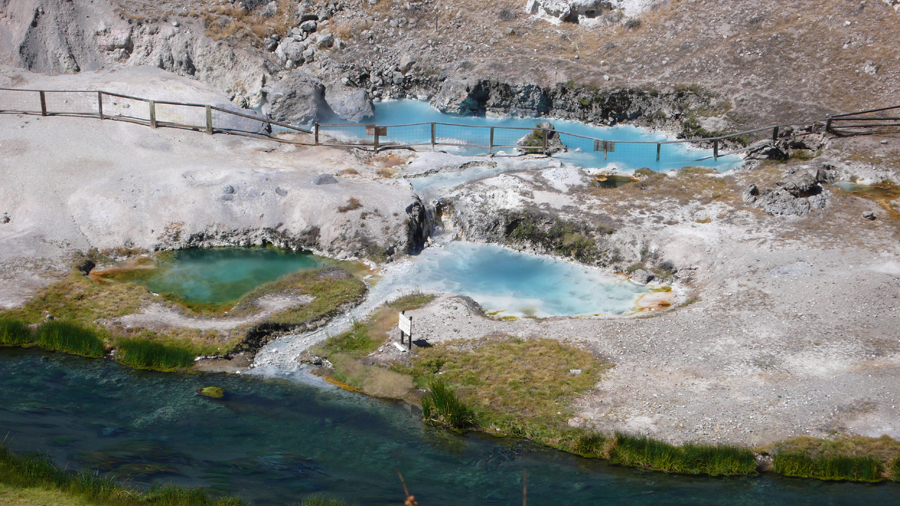
Of course the number one cause of death in uncontrolled hot springs is being boiled alive. This is actually more common than you would think. Water at 120 degrees Fahrenheit can scald you. Spend much time in a hot spring with waters exceeding this temperature and you will boil. Readers are probably aware of the tragic death which occurred in early 2017 when a young man accidentally fell into a thermal pool in Yellowstone National Park and was boiled to death. It was very sensational because his body was reported to have been dissolved before it could be retrieved. Not only are the hot springs in Yellowstone extremely hot but many of them are acidic with pH’s of 2. Hydrochloric acid is pH 2. A former park ranger has actually written an account of all the people who’ve died in hot springs in Yellowstone – 22 from his last account. In Idaho and Nevada, there have been reported cases of people being severely burned trying to rescue dogs from the scalding waters of a hot spring and a few of them have unfortunately died from their injuries. Even hot springs where people have bathed before without injury can suddenly and lethally change temperature. This generally occurs in areas where the water in thermal springs is heated by superhot rock in contact with magma. Hot Creek in California’s Long Valley Caldera is a notable example of hot springs which can drastically change temperatures as a result of geologic activity underground which seals off one fissure to the surface and opens another. There are reports of over a dozen people having died while bathing in the hot springs there. Sudden temperature changes could happen at any uncontrolled hot spring which is produced by active volcanism in the subsurface.
So this post was entitled Hot Springs: Risks and Rewards, but all you’ve read so far are the risks. What are the rewards? Well in a nice controlled spa environment, hot springs can be very relaxing and enjoyable. People have “taken the waters” for millennia and there are many health spas in Europe which still use hot springs therapeutically for the treatment of several diseases, including arthritis and psoriasis. Therapeutic treatment in hot springs was common in the United States for such illnesses until the early seventies when medical science actually started producing some pharmaceuticals which treat the symptoms of these diseases. The therapeutic use of spring water is called balneology. There have been a number of compilation studies examining the research conducted on the effectiveness of the therapeutic use of hot mineral water to alleviate symptoms of arthritis and other diseases. Unfortunately the studies all have the same conclusions. The research projects conducted have not been scientifically sufficient to conclude whether there are benefits achieved from balneotherapy. It doesn’t mean there aren’t benefits, it just means there is not a lot of conclusive evidence that such treatment works. But enjoy your soak in a hot spring anyway; just make sure it is in a controlled spa environment.